AI Superpowers by Kai-Fu Lee
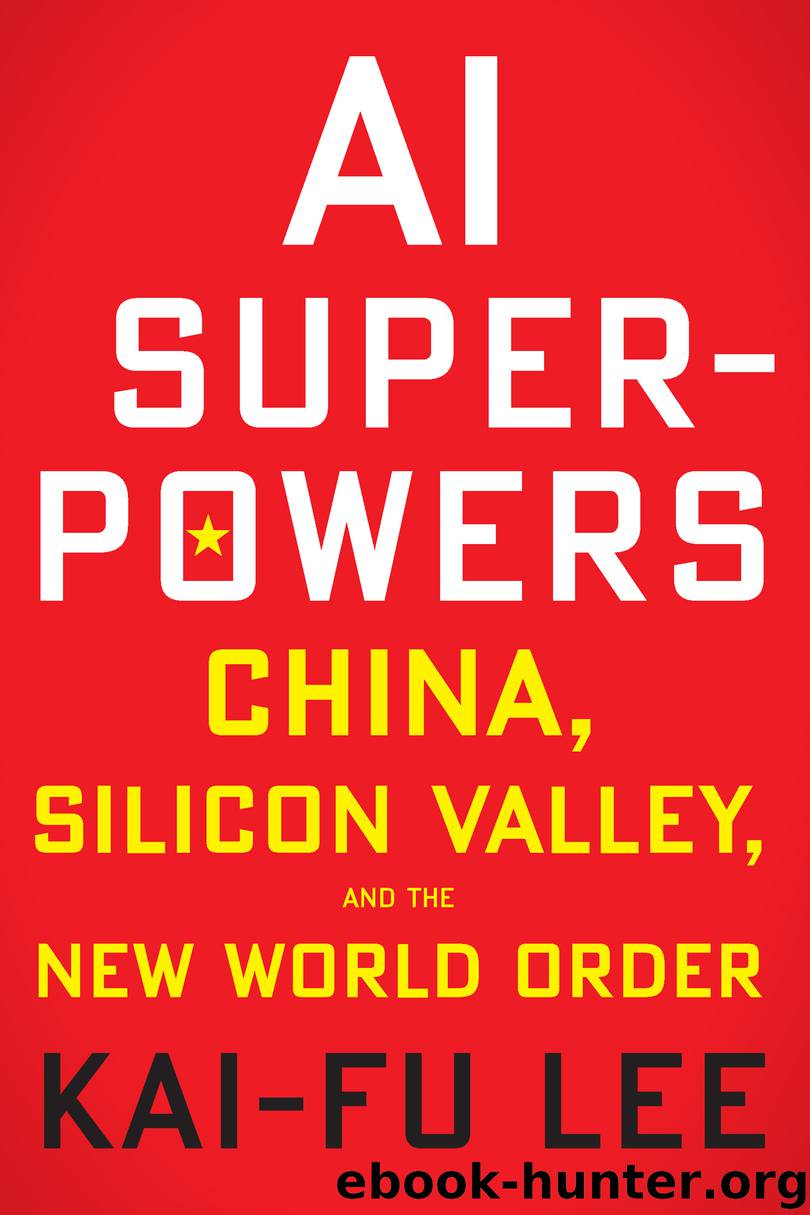
Author:Kai-Fu Lee
Language: eng
Format: epub, mobi
Publisher: Houghton Mifflin Harcourt Publishing Company
MI FIRST
The Chinese hardware startup Xiaomi (pronounced “sheow-me”) gives a glimpse of what a densely woven web of perception-AI devices could look like. Launched as a low-cost smartphone maker that took the country by storm, Xiaomi is now building a network of AI-empowered home devices that will turn our kitchens and living rooms into OMO environments.
Central to that system is the Mi AI speaker, a voice-command AI device similar to the Amazon Echo but at around half the price, thanks to the Chinese home-court manufacturing advantage. That advantage is then leveraged to build a range of smart, sensor-driven home devices: air purifiers, rice cookers, refrigerators, security cameras, washing machines, and autonomous vacuum cleaners. Xiaomi doesn’t build all of these devices itself. Instead, it has invested in 220 companies and incubated 29 startups—many operating in Shenzhen—whose intelligent home products are hooked into the Xiaomi ecosystem. Together they are creating an affordable, intelligent home ecosystem, with WiFi-enabled products that find each other and make configuration easy. Xiaomi users can then simply control the entire ecosystem via voice command or directly on their phone.
It’s a constellation of price, diversity, and capability that has created the world’s largest network of intelligent home devices: 85 million by the end of 2017, far ahead of any comparable U.S. networks. It’s also an ecosystem built on the Made-in-Shenzhen advantage. Low prices and China’s massive market are turbocharging the data-gathering process for Xiaomi, fueling a virtuous cycle of stronger algorithms, smarter products, better user experience, more sales, and even more data. It’s also an ecosystem that has produced four unicorn startups within Xiaomi’s ecosystem alone and is driving Xiaomi toward an IPO predicted to value the company at around $100 billion.
As perception AI finds its way into more pieces of hardware, the entire home will feed into and operate off digitized real-world data. Your AI fridge will order more milk when it sees that you’re running low. Your cappuccino machine will kick into gear at your voice command. The AI-equipped floors of your elderly parents will alert you immediately if they’ve tripped and fallen.
Third-wave AI products like these are on the verge of transforming our everyday environment, blurring lines between the digital and physical world until they disappear entirely. During this transformation, Chinese users’ cultural nonchalance about data privacy and Shenzhen’s strength in hardware manufacturing give it a clear edge in implementation. Today, China’s edge is slight (60–40), but I predict that in five years’ time, the above factors will give China a more than 80–20 chance of leading the United States and the rest of the world in the implementation of perception AI.
These third-wave AI innovations will create tremendous economic opportunities and also lay the foundation for the fourth and final wave, full autonomy.
Download
This site does not store any files on its server. We only index and link to content provided by other sites. Please contact the content providers to delete copyright contents if any and email us, we'll remove relevant links or contents immediately.
Waking Up in Heaven: A True Story of Brokenness, Heaven, and Life Again by McVea Crystal & Tresniowski Alex(37869)
Still Foolin’ ’Em by Billy Crystal(36404)
Cecilia; Or, Memoirs of an Heiress — Volume 1 by Fanny Burney(32635)
Cecilia; Or, Memoirs of an Heiress — Volume 2 by Fanny Burney(32010)
Cecilia; Or, Memoirs of an Heiress — Volume 3 by Fanny Burney(31996)
Fanny Burney by Claire Harman(26659)
Empire of the Sikhs by Patwant Singh(23135)
We're Going to Need More Wine by Gabrielle Union(19107)
Hans Sturm: A Soldier's Odyssey on the Eastern Front by Gordon Williamson(18648)
Plagued by Fire by Paul Hendrickson(17461)
Out of India by Michael Foss(16985)
All the Missing Girls by Megan Miranda(16307)
Cat's cradle by Kurt Vonnegut(15441)
Pimp by Iceberg Slim(14662)
For the Love of Europe by Rick Steves(14562)
Molly's Game by Molly Bloom(14194)
Bombshells: Glamour Girls of a Lifetime by Sullivan Steve(14135)
Leonardo da Vinci by Walter Isaacson(13407)
4 3 2 1: A Novel by Paul Auster(12505)
